Apify
FreemiumWeb scraping and data extraction platform with hundreds of ready-to-use actors to automate web data collection.
At a glance
Web scraping and data extraction platform with hundreds of ready-to-use actors to automate web data collection. Price : Free then from $45/month. Rating : 4.3/5.
Try ApifyCategory
Data Enrichment
Pricing
Free then from $45/month
Rating
4.3/5
Status
Verified ✓
Preview
What is Apify?
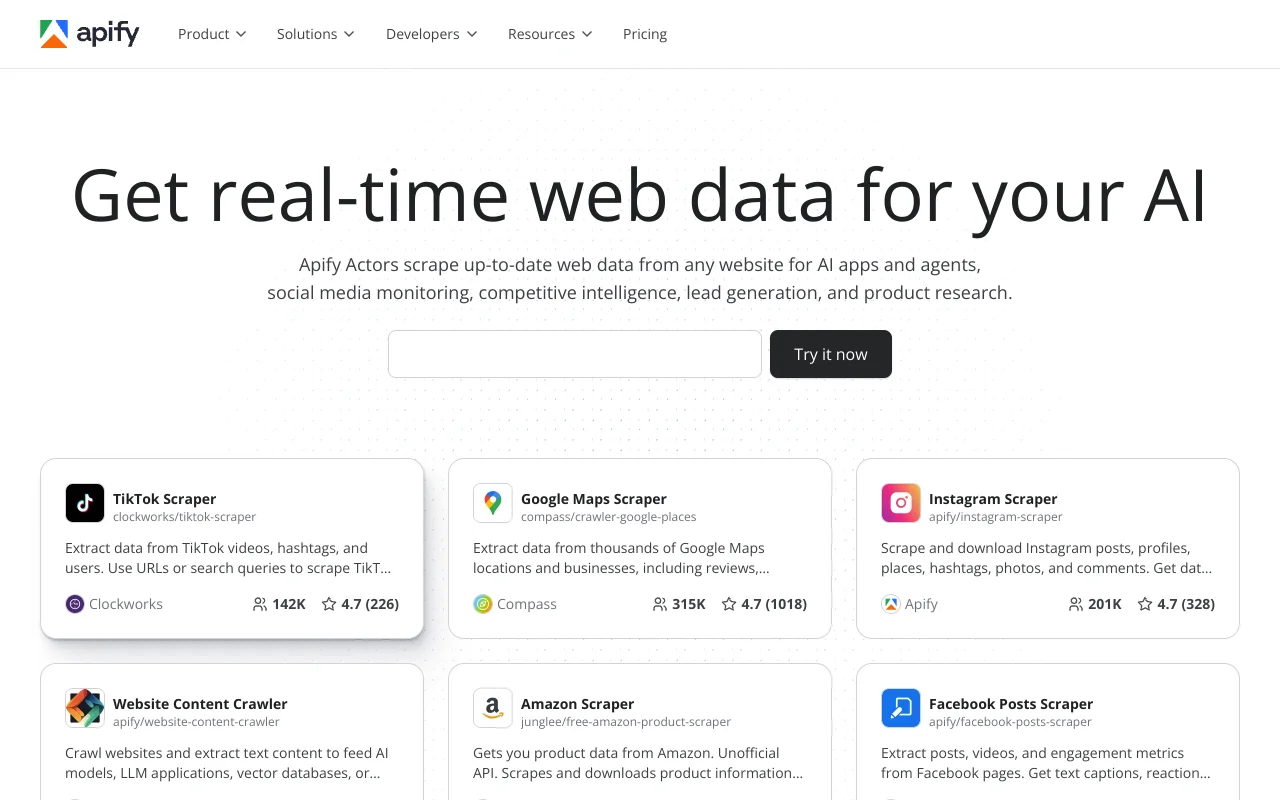
Apify is a cloud-based web scraping and automation platform that allows you to extract data from any website at scale. The tool is built on an ecosystem of "Actors" — ready-to-use scrapers and automations — available in the Apify Store, a marketplace with over 10,000 actors covering virtually all platforms: Google Maps, LinkedIn, Amazon, Instagram, Twitter/X, TikTok and many more.
Founded in Prague in 2015, Apify has established itself as the reference for industrial scraping, used by both independent developers and companies like Intercom and the European Commission. The platform is SOC 2 Type II certified and GDPR and CCPA compliant, making it one of the rare scraping solutions with a genuine compliance framework.
Key Features
Apify Store: the Actors marketplace
The heart of the Apify ecosystem. The Store offers over 10,000 ready-to-use Actors for various use cases: scrape Google Maps results, extract Amazon products, collect LinkedIn profiles, monitor competitor prices, retrieve TripAdvisor reviews. Each Actor is configured in just a few clicks with simple parameters (URL, keywords, filters) without writing a line of code.
Custom Actor development
For specific use cases, Apify lets you create your own Actors in JavaScript/TypeScript via Crawlee, their open-source framework. The SDK provides full control over scraping logic: headless browser management (Puppeteer, Playwright), proxy rotation, CAPTCHA handling, and results storage.
Proxy infrastructure and anti-blocking
Apify integrates a managed proxy pool with automatic IP rotation: datacenter, residential, and SERP proxies. The anti-blocking system simulates human behavior (browser fingerprints, random delays) to minimize detection risks. This is a major advantage over homemade scraping where proxy management is a persistent headache.
Scheduling and orchestration
Actors can be scheduled to run at regular intervals (hourly, daily, weekly) and chained into workflows. The system automatically handles errors, retries, and cloud storage of results in structured Datasets or Key-Value Stores.
Data for AI and agents
Apify is increasingly positioning itself as a data provider for generative AI applications and autonomous agents. The platform supports the Model Context Protocol (MCP) to directly connect scraped data to language models, and offers specialized Actors to power RAG pipelines or knowledge bases.
Integrations
Apify integrates into existing data workflows:
- Google Sheets: automatic export of scraping results
- Slack: real-time notifications on results and errors
- Zapier and Make (Integromat): connection with 5,000+ applications to automate flows
- Webhooks: trigger actions at the end of a scraping job
- Complete REST API for integration into custom systems
- JavaScript/Python SDK for developers
- MCP support to connect data to AI agents
Pricing
Apify operates on a consumption-based credit model. Each plan includes a monthly credit allowance, and the cost of an Actor depends on the computing power used, storage, and proxies consumed.
- Free — $0: $5 in monthly credits, access to most features, ideal for testing
- Starter — $45/month: $49 in monthly credits, basic scraping, email support
- Scale — $460/month: $499 in monthly credits, teams, advanced proxies, priority support
- Business — $920/month: $999 in monthly credits, dedicated support, guaranteed SLA
- Enterprise — custom pricing: custom credits, account manager, dedicated infrastructure
The free plan is genuinely usable for occasional scraping. For regular prospecting or monitoring, the Starter plan is sufficient in most cases. Costs increase mainly with the use of residential proxies on large volumes.
Strengths
- Massive marketplace of 10,000+ ready-to-use Actors — you'll find a scraper for virtually every platform
- Integrated proxy infrastructure and anti-blocking, avoiding the headache of managing proxies in-house
- Functional free plan that lets you test seriously before committing
- Transparent pay-as-you-go model: you pay for what you consume, no waste
- Open-source Crawlee framework to build custom Actors in JavaScript/TypeScript
- SOC 2 Type II, GDPR, and CCPA compliance — rare for a scraping tool
- Excellent scalability: from tens to several million pages scraped per month
- Responsive customer support and well-rated by the community
Weaknesses
- Steep learning curve for advanced features — you need JavaScript basics to go beyond pre-configured Actors
- The consumption-based credit model can make costs hard to predict, especially with residential proxies
- Some Actors in the Store become obsolete when target sites change their structure — you need to check update dates
- The interface can seem complex for non-technical beginners facing the number of available options
- Scheduling features lack flexibility for dynamic date ranges
- Support can be slow on the free plan — paid plans offer better responsiveness
Our Verdict
Apify is the reference platform for large-scale web scraping. Its strength lies in the combination of a massive Store of ready-to-use Actors and solid technical infrastructure (proxies, anti-blocking, orchestration). For GTM teams, it's a formidable tool for building prospect lists from Google Maps, LinkedIn, industry directories, or competitor websites.
The tool excels in two scenarios: one-off scraping via Store Actors (accessible to everyone) and custom industrial scraping via the Crawlee SDK (for technical profiles). The free plan is a genuine entry point, and the consumption model remains competitive — teams scraping 100,000 data points per month typically spend between $230 and $370, which is less than most competitors.
The main limitation is technical: to get the most out of Apify beyond basic Actors, you need development skills. If you're looking for a pure no-code tool for simple scraping, PhantomBuster will be more accessible. But for volume and reliability, Apify is hard to beat.
Average rating: 4.6/5 — based on reviews from G2 (4.8/5), Capterra (4.8/5), and TrustPilot (4.5/5).
Frequently Asked Questions
Is Apify legal?
Apify extracts publicly accessible data and is GDPR compliant, CCPA compliant, and SOC 2 Type II certified. However, the legality of scraping depends on the terms of service of each target website. Apify provides a compliant technical framework, but responsibility for data use remains with the user.
Do you need to know how to code to use Apify?
No, for common use cases. Store Actors are configured without code, with simple parameters. However, to create custom Actors or manage complex workflows, JavaScript knowledge is necessary.
What's the difference between Apify and PhantomBuster?
PhantomBuster is focused on LinkedIn automation and social networks with a no-code approach. Apify is a more general-purpose and technical scraping platform, covering all types of websites with finer control. Apify is more powerful for large volumes and custom use cases, PhantomBuster is more accessible for LinkedIn prospecting.
Updated on March 19, 2026

Elliot Tram
Founder, GTM Stack
Passionate about growth and SaaS tools, I help GTM teams build an efficient stack without unnecessary complexity.
Follow on XOther tools in Data Enrichment
DiscoLike
★ 4.3/5Business intelligence platform that identifies your ideal target accounts among 60M+ companies through natural language search, lookalike matching by similar domains, and web data enrichment.
Clay
★ 4.8/5B2B data enrichment and prospecting automation tool.
Latest tools listed
Descript
★ 4.5/5All-in-one video and audio editor with AI transcription. Edit your podcasts and videos by editing text — like Google Docs for video.
Reviewflowz
★ 4.1/5Customer review management tool that allows you to collect, monitor, and respond to reviews across all platforms to improve your online reputation.
SocialBee
★ 4.3/5Social media management and planning tool with content categorization and automatic post recycling. Multi-platform support.