At a glance
B2B data enrichment and prospecting automation tool. Price : Free ($0) • Launch ($167/mo) • Growth ($446/mo) • Enterprise (custom). Rating : 4.8/5.
Try ClayCategory
Data Enrichment
Pricing
Free ($0) • Launch ($167/mo) • Growth ($446/mo) • Enterprise (custom)
Rating
4.8/5
Status
Verified ✓
Preview
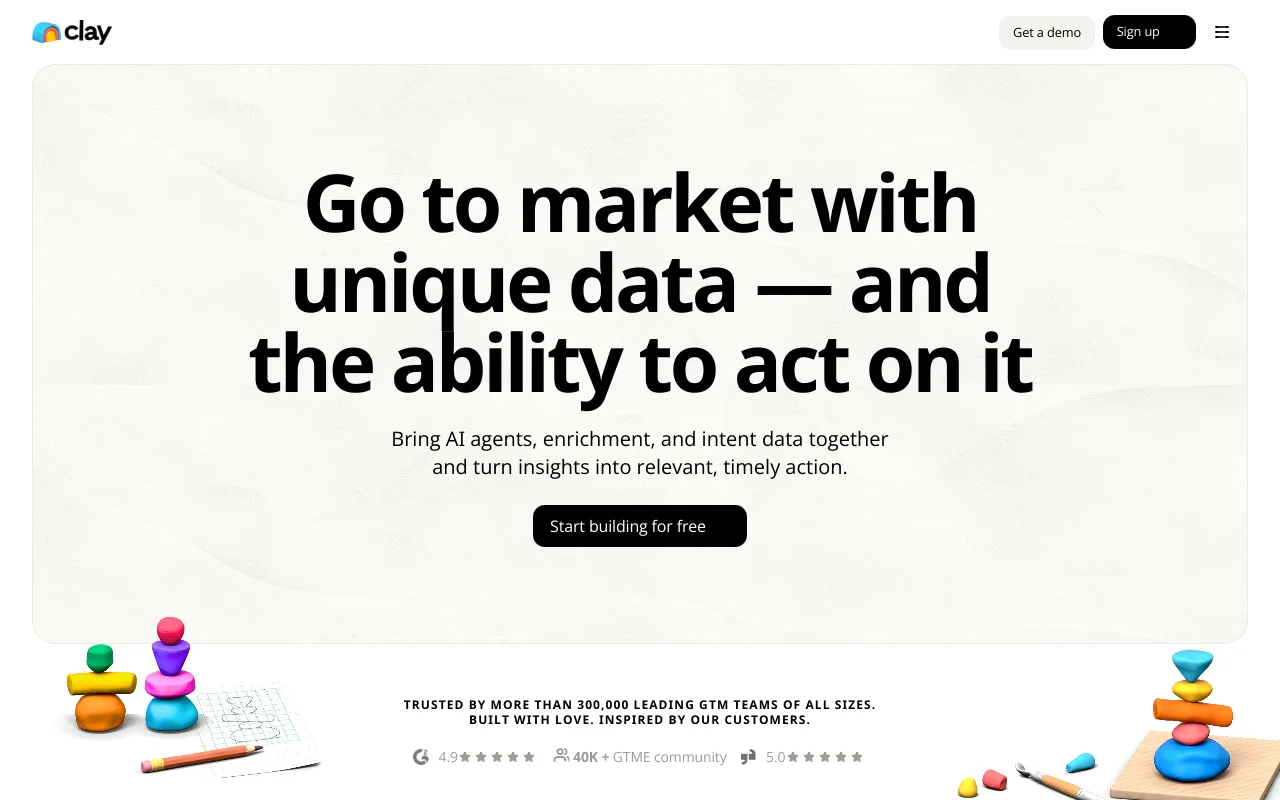
What exactly is Clay?
Clay is a Go-To-Market data orchestrator. In practice, it centralizes over 150 B2B data providers in a single interface. You build prospect lists, automatically enrich them, and launch hyper-personalized campaigns. All without writing a single line of code.
Founded in 2017 in New York, Clay raised $100 million in Series C (June 2025) for a $3.1 billion valuation. Over 300,000 GTM professionals use it: including teams at OpenAI, Anthropic, Notion, Intercom, and Rippling.
The basic idea is simple: instead of juggling Apollo, Clearbit, Hunter, Dropcontact, and five other tools, Clay queries them all from the same spreadsheet. You only pay for the credits you use.
Features that make the difference
Waterfall Enrichment
This is the killer feature. Clay sequentially queries multiple data providers for the same field (email, phone, job title, etc.). If Hunter finds nothing, it moves to Dropcontact, then to People Data Labs, and so on. Result: 2 to 3 times better coverage than any single provider.
OpenAI publicly documented going from 40% to 80% enrichment rate thanks to this system. That's the kind of result that justifies the price.
Claygent: the AI research agent
Claygent is an autonomous agent that fetches unstructured information from the web. It can analyze a prospect's website, scrape their careers pages, detect technologies in use, or summarize recent company news. Over one billion cumulative executions to date.
In practice, this means you can enrich your prospects with data that no database stores. "Is this company hiring SDRs?", "What's their tech stack?", "Did they raise funds recently?": Claygent will find the answer.
Intent signals
Clay automatically detects the right moments to contact a prospect: job change, funding round, new job posting, competitor mention. These are the signals that turn a cold email into a relevant message.
Sculptor: the natural language workflow builder
Sculptor lets you describe a workflow in natural language and Clay builds it automatically. "Find VP Sales at B2B SaaS companies in France who changed jobs in the last 3 months, enrich their emails, and generate a personalized pitch." It's powerful, though still imperfect on complex cases.
Integrations and sequencer
Clay natively connects to Salesforce, HubSpot, Pipedrive, and major email sequencers. It also has its own sequencer (Clay Sequencer) to send campaigns directly. In 2026, it also syncs audiences to LinkedIn Ads, Meta, and Google Ads: a feature not found in competitors.
How much does it cost? (2026 pricing)
Clay recently updated its plans. Here's the current pricing:
Free: $0/month: 500 actions, 100 data credits. Good for testing. Limited to 200 rows per table, no CRM sync.
Launch: from $167/month: 15,000 actions, 2,500 to 50,000 data credits. Phone enrichment, job change tracking, up to 50,000 rows per table. This is the plan that covers 90% of teams according to Clay.
Growth: from $446/month: 40,000 actions, 6,000 to 50,000 data credits. Automatic CRM sync, webhooks, HTTP API, web intent signals, ad audiences. This is the recommended plan for structured teams.
Enterprise: custom pricing: 200,000+ actions, 100,000+ credits. Data warehouse sync (Snowflake), SSO, RBAC, dedicated Growth Strategist.
Annual plans offer 10% discount. Unused credits roll over (up to 2x monthly allocation). Cost per credit starts at $0.05 and decreases with volume.
Watch out for hidden costs
Let's be honest: Clay's pricing is complex. Credits burn quickly when testing workflows. A verified email costs 1-2 credits, but a phone number can go up to 25 credits. Many users report overages of $500 or more during the learning phase.
Mid-month top-ups are marked up 50%. And API rate limits can slow large volumes. Worth planning for.
Who Clay is for (and who it isn't)
Clay is for you if…
- You enrich more than 5,000 leads per month
- Your team has a RevOps or Growth Engineer profile
- You prospect internationally (US, UK, Europe)
- You already use multiple data tools (Apollo, Clearbit, Lusha, etc.)
- Your CRM is structured and clean
Skip it if…
- You're a small French company with fewer than 10 salespeople and a tight budget
- You don't have anyone technical on your team
- You only prospect in France (coverage is average)
- You're looking for a plug-and-play tool with no setup required
What we love
The enrichment power is incomparable. No tool on the market offers this level of multi-source coverage. The spreadsheet interface is familiar and flexible: you build complex workflows without coding. Seats are unlimited on all plans, which is rare. And on compliance, it's solid: SOC 2 Type II, ISO 27001, GDPR compliant.
The community (40,000+ members) and educational resources (Clay University, certifications) make onboarding easier. It's a real ecosystem.
What doesn't work
The learning curve is steep. Really steep. Clay isn't a tool you master in an afternoon. Plan for several days to get comfortable, and it burns credits during the testing phase.
Pricing is hard to predict. Between action credits, data credits, marked-up top-ups, and throttling, you need to monitor usage closely. Native CRM integration only comes at the Growth plan ($446/month): that's a barrier for many teams.
On the French and European market, data coverage is below what you get in English-speaking markets. If you prospect only in France, specialized tools like Societeinfo or Dropcontact offer better coverage-to-price ratio.
Clay vs the competition
Clay doesn't replace a single tool: it orchestrates them. That's a fundamental difference.
Against Apollo ($49/month/user), Clay is significantly more expensive but offers superior data coverage thanks to waterfall. Against ZoomInfo (~$15,000/year), Clay is more flexible and cheaper for equivalent features. Against Cognism (~$1,000/month), Clay wins on multi-source enrichment but loses on European coverage and ease of use.
For French teams doing multi-channel outreach, La Growth Machine ($60/month) remains a far more accessible alternative: but it's a different category in terms of enrichment capability.
Our verdict
Clay is arguably the most powerful B2B enrichment tool on the market in 2026. It's the secret weapon of GTM teams with the budget and technical maturity to exploit it. The ability to combine 150+ data sources in a no-code workflow is unique.
But it's a demanding tool. It requires time, substantial budget, and technical expertise on your team. If you check these boxes, go for it: the free 14-day trial (no credit card required) will let you validate if it fits your use case.
If you're just starting with prospecting or your budget is tight, start with Apollo or La Growth Machine instead. You can always upgrade to Clay when your volumes justify the investment.
Frequently asked questions
Is Clay free?
Yes, there's a free plan with 500 actions and 100 data credits per month. Enough to test the tool, but too limited for real use.
Is Clay GDPR compliant?
Yes. Clay is SOC 2 Type II certified, ISO 27001 certified, and GDPR and CCPA compliant. Data is processed to enterprise standards.
How long to master Clay?
Plan for 3 to 5 days for the basics. Full mastery takes several weeks. Clay University and the Slack community (40,000 members) speed up the learning curve.
Does Clay work well for the French market?
Coverage is decent but lower than English-speaking markets. For 100% France prospecting, tools like Societeinfo or Dropcontact will be more relevant. Clay excels internationally.
Can you use Clay without technical skills?
Technically yes, thanks to Sculptor and the no-code interface. In practice, having a RevOps or Growth Engineer on your team is nearly essential to get maximum value.
Updated on March 16, 2026

Elliot Tram
Founder, GTM Stack
Passionate about growth and SaaS tools, I help GTM teams build an efficient stack without unnecessary complexity.
Follow on XOther tools in Data Enrichment
DiscoLike
★ 4.3/5Business intelligence platform that identifies your ideal target accounts among 60M+ companies through natural language search, lookalike matching by similar domains, and web data enrichment.
Apify
★ 4.3/5Web scraping and data extraction platform with hundreds of ready-to-use actors to automate web data collection.
Latest tools listed
Descript
★ 4.5/5All-in-one video and audio editor with AI transcription. Edit your podcasts and videos by editing text — like Google Docs for video.
Reviewflowz
★ 4.1/5Customer review management tool that allows you to collect, monitor, and respond to reviews across all platforms to improve your online reputation.
SocialBee
★ 4.3/5Social media management and planning tool with content categorization and automatic post recycling. Multi-platform support.